The Quiet Bond Nobody's Photographing: Why Fathers and Sons Deserve More Space in Your Family's Visual Story
The Quiet Bond Nobody's Photographing: Why Fathers and Sons Deserve More Space in Your Family's Visual Story
Flip through the average American family's photo album — digital or otherwise — and a pattern starts to emerge pretty fast. Mom and daughter at the beach. Mom holding the baby. Mom laughing at the kitchen table with the kids piled around her. Those images are beautiful, and they matter deeply. But scan a little further and you'll notice something missing. The father-son relationship — that particular, understated, often wordless connection — is barely there. A few birthday shots, maybe a holiday or two. And then silence.
This isn't an accident. It's a reflection of how we've been taught to see masculine relationships: as things that don't need to be documented because they don't ask to be seen. But that invisibility comes at a cost. And most families don't feel it until the window has already closed.
Why the Camera Tends to Look Away
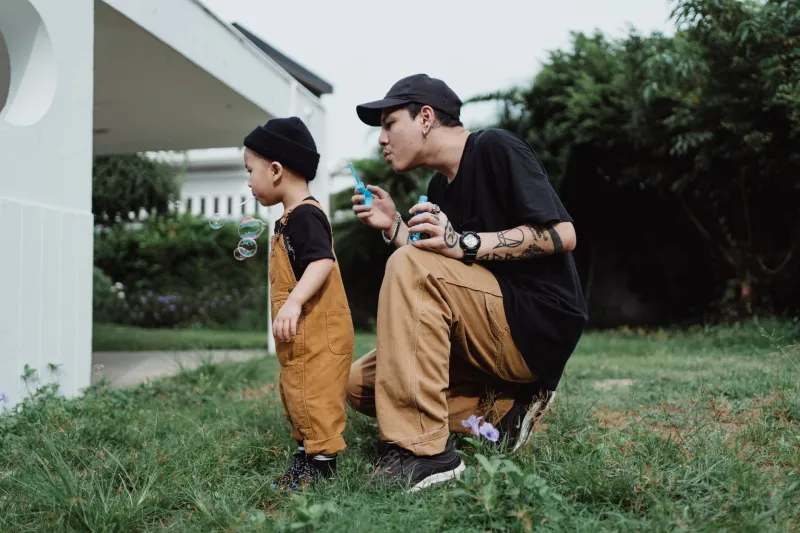
There's a cultural story we tell ourselves about how men connect. It's not through long conversations or tearful embraces — at least not often. It's through doing things side by side. Fixing the car. Watching the game. Throwing a ball in the backyard until the light goes flat. These moments don't announce themselves as significant. They're low-key, almost mundane on the surface. And that's exactly why they fall outside the frame so consistently.
When families book portrait sessions, the instinct is usually to capture the big, legible emotions. The hugs. The laughter. The obvious tenderness. Fathers and sons often communicate in a different register — one that looks like two people just existing near each other, and that can feel hard to photograph intentionally.
Add to that the fact that many dads are the ones behind the camera, and you've got a recipe for a near-total absence. Dads document. They don't often get documented. By the time a son grows up and starts looking back through family photos, his father is a ghost — present in the margins, almost never at the center.
What's Actually Worth Photographing
The gestures that define a father-son relationship are specific, and once you start looking for them, they're everywhere.
There's the handshake that evolves over decades — from a small kid mimicking his dad's firm grip, to two grown men meeting each other as equals for the first time, to an old man whose hand trembles slightly in his son's steadier one. That handshake tells a whole story, and almost nobody has a photograph of it.
There's the posture. The way a teenage son starts to mirror his dad's stance without realizing it. The way they both lean against the truck the same way. The way they both go quiet at the same moment during a tough conversation.
There's the teaching ritual — whether it's casting a fishing line, changing a tire, measuring twice before cutting once. These aren't just skills being passed down. They're a language. A way of saying I see you, I'm investing in you, I'm here.
And there's the silence itself. Two people watching a sunset or sitting on a porch without needing to fill the air. That particular kind of comfort is hard-won and deeply human, and it photographs beautifully when you know what you're looking for.
The Ages That Matter Most — and Go Fastest
Father-son relationships shift dramatically across time, and each phase deserves its own visual record.
When a son is young — five, six, seven — his dad is basically a superhero. The way a little boy looks up at his father is something that will never exist again once it's gone. That specific gaze, full of wonder and complete trust, is gone in a blink.
The middle years — roughly ten through fifteen — are underrated and often skipped over photographically. But this is when the dynamic starts to get interesting. The son is becoming his own person. There's friction, and there's also a deepening. It's complicated in a way that's worth capturing.
The teenage and early adult years tend to be the most visually absent of all. Teenagers don't want to be photographed, and their dads often feel the same way. But this is also when the relationship is quietly rebuilding itself on different terms — and those are some of the most meaningful images a family can have.
And then there's the later chapter. Fathers aging. Sons stepping into roles they didn't expect. The power dynamic shifting in ways that are sometimes tender and sometimes hard. These moments almost never get documented, and they should.
What a Portrait Session Can Actually Look Like
If you're picturing a stiff studio setup with forced smiles, let that image go. The best father-son sessions I've ever been part of looked nothing like that.
They looked like a dad teaching his son to cast a rod at a local lake, the afternoon light catching the water just right. They looked like two guys working on something in a garage, talking without looking at each other the way men do. They looked like a son helping his aging father walk across uneven ground — a quiet role reversal neither of them commented on.
The goal isn't to manufacture emotion. It's to create a little space for what's already there to show up on its own. When you give a father and son permission to just be together, in front of a camera that isn't asking them to perform, something real almost always surfaces.
It doesn't have to be elaborate. It doesn't have to be a big production. It just has to happen before it can't anymore.
Before the Window Closes
Here's the honest truth: most families wait too long. They assume there will be more time. Another summer, another holiday, another chance to get everyone together and actually do this right. And then something changes — a move, an illness, a death — and they're left searching through old photos for something that was never there to begin with.
The father-son bond is one of the most quietly significant relationships in American family life. It shapes who men become, how they love, how they handle hard things, and what they carry forward into the next generation. That deserves to be seen. It deserves to be preserved.
If you have a father and son in your life — whether that's you and your dad, you and your boy, or a relationship you want to honor — don't wait for the obvious occasion. Don't wait until someone is sick or the family is gathered for a funeral and you're wishing you had one real photograph.
Step in front of the lens together. Let the camera see what words have never quite been able to say.
That's what portraits are for.