Ghosts in a Canister: What Happens When You Finally Develop the Film Your Grandmother Never Did
The Canister at the Bottom of the Drawer
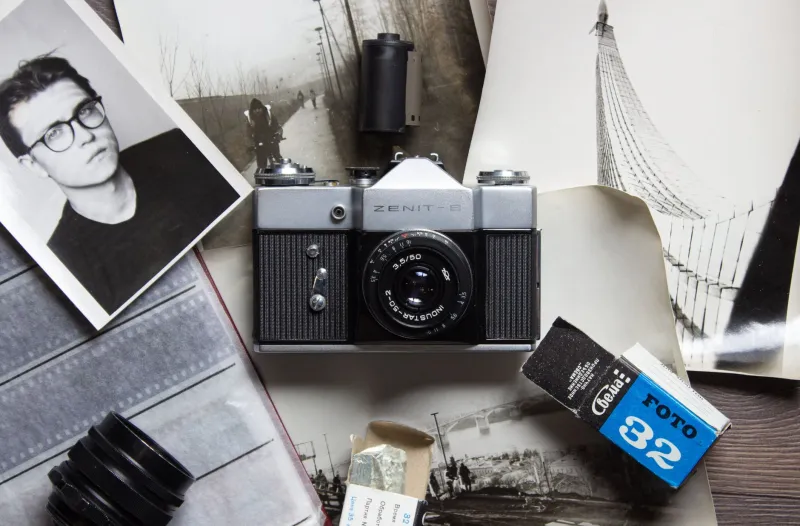
You're going through the nightstand. Or the coat closet. Or a shoebox tucked behind winter sweaters that haven't moved in fifteen years. And then your hand finds it — a small plastic film canister, the lid still snapped tight, the roll inside untouched. Undeveloped. Waiting.
For a lot of Americans, this is the moment grief gets complicated in a way nobody warned them about.
Undeveloped film found in the belongings of someone who has passed away is more common than most people realize. It shows up in estate sales, in storage units, in the junk drawers of people who shot on 35mm through the '70s, '80s, and '90s — decades when film was the only way to hold onto a moment. And because developing cost money, because life got busy, because there was always next week — some rolls just never made it to the drugstore counter. They sat. They waited. And eventually, the person who loaded them into the camera was gone.
What happens to those rolls matters more than you might think.
What It Means to Finally Press Play
There's a growing community of people — a quiet, tender corner of the internet — who are paying to have these orphaned rolls developed. Reddit threads, Facebook groups, even dedicated services have popped up to help families navigate the process. Some labs specialize in pushing old, expired film to coax out whatever images might still be hiding there. The results are never guaranteed. Decades of heat, light exposure, and time degrade the emulsion. Some rolls come back completely blank. Others return with images so faded they look like watercolor memories. And sometimes — sometimes — you get something sharp and clear and devastating.
A birthday party you never knew happened. A road trip nobody talked about. A face you recognize immediately, younger than you ever knew them, laughing at something just outside the frame.
Photography has always been about freezing time, but undeveloped film is something stranger and more profound. It's time that was frozen and then never looked at. A moment that existed in light and chemistry and was sealed away before it could become a memory for anyone else. Developing that film isn't just a technical process. It's an act of inheritance.
The Hope Baked Into Every Exposed Frame
Here's what strikes me most about this phenomenon, as someone who thinks constantly about what photographs actually are and why we make them.
Every time someone loaded film into a camera and pressed the shutter, they were making a bet on the future. They were saying, I believe I will be around to see this developed. I believe this moment is worth keeping. I believe there will be a later. Photography is, at its core, an optimistic act. You don't photograph what you think will be forgotten. You photograph what you hope will be remembered.
Undeveloped film is that hope, preserved in chemical form, waiting for someone else to cash it in.
There's something quietly profound about the idea that your grandmother — or your father, or your college roommate, or a stranger whose estate sale you wandered into — once stood somewhere and decided a moment was worth saving. She raised the camera. She chose the frame. She clicked the shutter. And then life moved on, and the film stayed in the drawer, and now you're holding it, decades later, with the power to finally see what she saw.
Why Americans Are Seeking These Images Out
The interest in developed found film has grown significantly in recent years, and it's not hard to understand why. We live in an age of infinite digital images — cloud backups, camera rolls that scroll for twenty minutes, photos taken and immediately forgotten. The scarcity of film photography has made it feel sacred again, especially to younger generations who never shot on it themselves.
But undeveloped film from a lost loved one carries something even heavier than nostalgia. It carries the specific weight of a story you didn't know you were missing.
Families who have gone through this process describe it in strikingly similar ways. There's the anticipation while you wait for the lab to return the scans. There's the strange ritual of opening the file or the envelope. And then there's what one woman in an online forum described as "seeing my mom's eyes before she was my mom" — a photograph of her mother as a young woman, taken by someone whose name she'll never know, on a day she'll never be able to ask about.
That's not just a photograph. That's a door opening into a room you didn't know existed.
The Ethics and Emotion of Developing Someone Else's Film
It's worth sitting with the complicated feelings this raises. These were private images. The person who took them never chose to share them. Does developing the film honor their memory, or does it cross a line they never got to draw?
Most people who wrestle with this question land in roughly the same place: the act of taking a photograph is itself an act of wanting it to exist. Nobody loads film into a camera hoping the images will disappear. The intent was always for these frames to be seen — the circumstances just never aligned. Developing the film feels less like an invasion and more like completing something that was always meant to be finished.
That said, what you do with the images afterward is a different conversation. Some families keep them entirely private. Others share them with relatives who appear in the photos. A few have posted them online — anonymized, handled with care — as a way of honoring the visual life of someone who is gone.
There's no single right answer. But the conversation itself says something beautiful about how seriously we take photographs as objects of meaning.
Light That Outlasted the Person Who Caught It
At its heart, this is what photography has always been — a negotiation between the present and the future, between what we see and what we hope someone else will one day understand. The light that hit your grandmother's film was real light, from a real day, bouncing off real faces. It's been sitting in chemical suspension ever since, waiting.
When you finally develop that roll, you're not just getting pictures. You're getting proof that someone paid attention. That someone looked at the world around them and thought: this is worth keeping.
That's the most human thing I can imagine. And it's the thing that makes photography — even decades-old, expired, uncertain photography — one of the most powerful forms of storytelling we have.
If you find a roll of film in someone's belongings, develop it. Whatever comes back, it will tell you something true.