Stop Asking Them to Smile: What the Eye-Roll Actually Looks Like in a Frame
Let me paint you a picture.
A fifteen-year-old is standing in a field at golden hour. The light is doing everything right — warm, directional, the kind of soft glow that makes every subject look like a painting. Her mom is off to the side, whispering encouragements. Just smile, honey. Come on. Just one good one.
The fifteen-year-old stares directly into my lens with the flat, unamused expression of someone who has been dragged here against her will and would like everyone to know it.
I take the shot.
It's one of the best frames from the entire session.
The Myth of the Cooperative Teenager
Somewhere along the way, we decided that a successful portrait of a teenager looks like a smiling, cooperative, slightly-posed version of the person we're trying to capture. We fight for that image. We bribe, cajole, negotiate. We say just five more minutes and your grandparents are going to love these and you can go home right after this.
And sometimes we get the smile. It's tight, slightly performative, and gone the second the shutter clicks.
Then we wonder why those images feel hollow when we look at them five years later.
Here's the thing about teenagers: they are developmentally wired to resist performance. The entire project of adolescence is about figuring out who you actually are versus who everyone wants you to be. When you ask a fifteen-year-old to stand still and smile on command, you're asking them to perform — and they know it, even if they can't articulate why it feels wrong.
The resistance isn't the obstacle. The resistance is the data.
What the Uncooperative Frame Actually Shows
When a teenager turns away from the camera, you capture the line of their jaw, the particular way they hold their shoulders, the self-consciousness and the defiance tangled up together in a posture that is uniquely, unmistakably them right now.
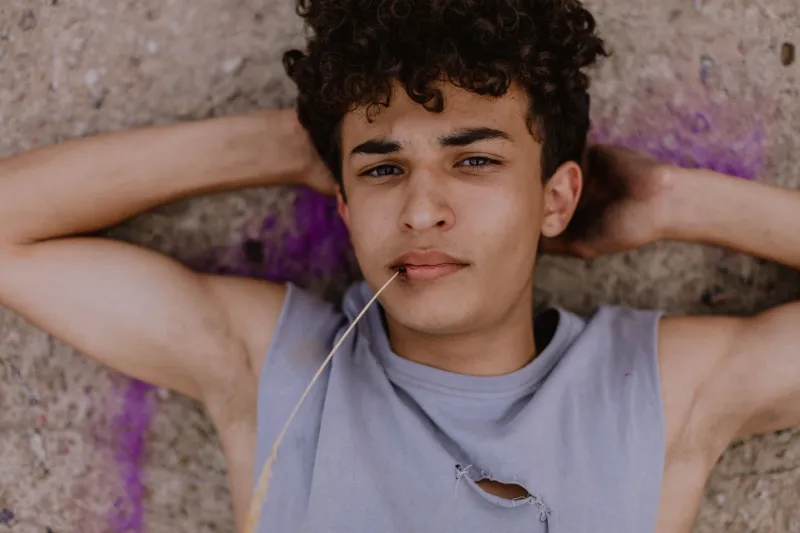
When they stare at you with that flat, unimpressed expression, you get something rarer than a smile: you get their eyes. Unguarded, direct, slightly challenging. That's not a bad photo. That's a character study.
When they laugh — not at your joke, but at how ridiculous the whole situation feels — you get something completely unrepeatable. The real laugh. The one they use with their friends. Not the one they perform for adults.
Authenticity doesn't require cooperation. It requires presence. And teenagers, bless them, are almost always fully present in their own discomfort.
Shifting Your Approach Behind the Lens
If you're a photographer working with adolescents, the fastest way to get nowhere is to keep pushing for the posed shot. Here's what actually works.
Give them something to do instead of somewhere to stand. Movement breaks the self-consciousness cycle. Ask them to walk. Ask them to find a spot they actually like. Ask them to show you something nearby that they think is interesting. The second they're focused on a task, their face relaxes into something real.
Stop narrating what you want. "Okay, now smile" is the most effective way to produce a fake smile in human history. Instead, talk to them. Ask genuine questions. Not "what are your hobbies" — but what's the last thing that actually made you laugh? or what's something you're kind of obsessed with right now that most people don't know about? Then photograph the answer.
Acknowledge the awkwardness out loud. Teenagers respect honesty more than almost anything. Saying "I know this is kind of weird and uncomfortable" immediately lowers the temperature in the room. You're not their enemy trying to extract a performance. You're a person who also finds posed photography slightly absurd sometimes. That's common ground.
Photograph the in-between moments. The best frames almost always happen when the subject thinks the session is paused — when they're checking their phone, laughing at something their sibling said, readjusting their jacket. Keep shooting. Those are the frames that last.
For the Parents in the Room
I know it's hard to watch your kid refuse to participate in something you've put time and money into. I know you have a vision of a beautiful, smiling portrait that you can put on the wall and feel good about.
But I want to ask you something: when you look at photos of yourself as a teenager, which ones feel most like you? Is it the posed school photo where you're smiling exactly the way you were told to? Or is it the candid one — maybe a little blurry, maybe mid-laugh, maybe staring at something just off-camera — where you can actually see yourself in there?
Your teenager's resistance isn't failure. It's personality. It's the specific, unrepeatable texture of who they are at this exact age, before life smooths some of those edges down. Twenty years from now, that flat stare into the camera is going to be the most honest document of who they were at fifteen that you own.
Let me photograph it.
The Portrait You'll Actually Keep
I've had parents come back to me years after a session and point to the exact frames they thought were "bad" at the time — the ones where their kid wasn't smiling, wasn't looking at the camera, was clearly somewhere else in their head — and say that's the one. That's them.
Not the posed smile. The real one.
The eye-roll, it turns out, is timeless. The performance isn't.
So next time your teenager crosses their arms and stares at you like you've personally wronged them by suggesting a family photo — take the shot. Don't fix it. Don't negotiate. Just let them be exactly who they are.
That's the portrait worth keeping.